She changed. He didn’t.
Why a man can feel less useful than the traditional man he grew up with, what happened to his role while the world moved on, and who stepped into that gap when nobody told him what was supposed to take its place.
You want to matter. But you feel less and less needed.
You may recognise it. You want to contribute something, to your family or to society. To be useful: the protector, the breadwinner, the leader, the fixer.
But more and more of those jobs have been taken over. The welfare state took over the protecting. Women became financially independent and claimed their place at work.
And here is a pain that almost never gets named: in the old system, "being a man" was pretty much the same thing as "being useful". We only feel worth something once we feel useful. Only nobody told us what was supposed to take its place.
This isn’t your fault.
You inherited a role nobody ever updated.
To understand how this came about, you first have to see what happened to the world around him.
The world moved on. The man’s role didn’t.
In a hundred and fifty years, women rewrote their place in society at speed. From legal property to full autonomy, in four waves. Her role was updated to the 21st century: free, and hers to define.
The man’s role stayed put. We’re running 2026 on 1850 software. Three pillars his status once rested on have lost their value, and nobody ever wrote a new version.
Her, four waves
- 1The vote. From property to citizen.
- 2The pill and a job. Her own money, her own choices, no longer dependent.
- 3Her own identity. "Femininity" became something you define yourself.
- 4#metoo. The collective end of quietly carrying the bill.
Him, three pillars, obsolete
- ×Muscle. Machines and AI do the heavy lifting. In an economy that runs on knowledge, physical strength buys little status or income.
- ×Stability (pushing feelings down). Knowledge work and teamwork run on collaboration and emotional intelligence. Shutting your feelings off is no strength there; it’s a brake.
- ×The breadwinner. Two incomes are the norm and she earns her own money. The sole claim on "providing" is gone.
The only one who did give him a story.
A boy rarely does anything wrong on purpose. He is looking for where his value sits, whether he matters, whether he is worth anything. And from society he mostly hears what he is doing wrong, and what he is no longer allowed to be.
And then there’s one party that does tell him what he can become. That offers brotherhood, a clear identity, and a concrete step-by-step plan for status. For a boy who is searching, a story that promises to make him worth more and more attractive, even if it’s only half true, beats no story at all.
The manosphere isn’t the source of the crisis. It’s a logical response to something society failed to do. And it earns credibility by naming things the polite debate would rather wave away:
Your usefulness counts
That a man’s worth still often hangs on his usefulness, on what he can do, has, protects, rather than on fine words about unconditional self-worth.
Words and deeds
That men feel a gap between what society says it wants, the open and caring man, and what it actually rewards. Put care first or adjust your work around your family, and on average you hand in pay and status. The signal is mixed, and men pick that up sharply.
Ownership
The message that you’re responsible for your own state. That hands a powerful sense of control back to a generation that feels rudderless.
Your energy is allowed
Masculinity, competitiveness and physical energy aren’t written off as a problem, but converted into discipline, fitness, martial arts and goals.
You aren’t the problem
It doesn’t treat masculinity as a defect, and it does take the pain behind it, loneliness and suicide, seriously. Recognition opens a window where the accusation "men are the perpetrators" slams the door.
The dating market
That men often experience dating as harsh and superficial, certainly on apps, and that this is frequently not imagined. Although in a real meeting, personality and emotional qualities turn out to weigh far more heavily than that surface-level filtering suggests.
History isn’t a scoreboard of good men.
The manosphere’s story looks backwards: to Rome, to soldiers, to emperors and kings, to a time that seemed to be run by "real men". That longing makes sense. But the history books mostly kept the loudest and the most powerful, not the best. The men who were simply there, and the brave women, the slaves and the poor farmers, rarely left a trace.
And even the hero the manosphere puts front and centre, Marcus Aurelius, points the other way. For the Stoics, strength isn’t winning the dominance game, but no longer depending on what other people think of you.
→ The full story of Marcus Aurelius
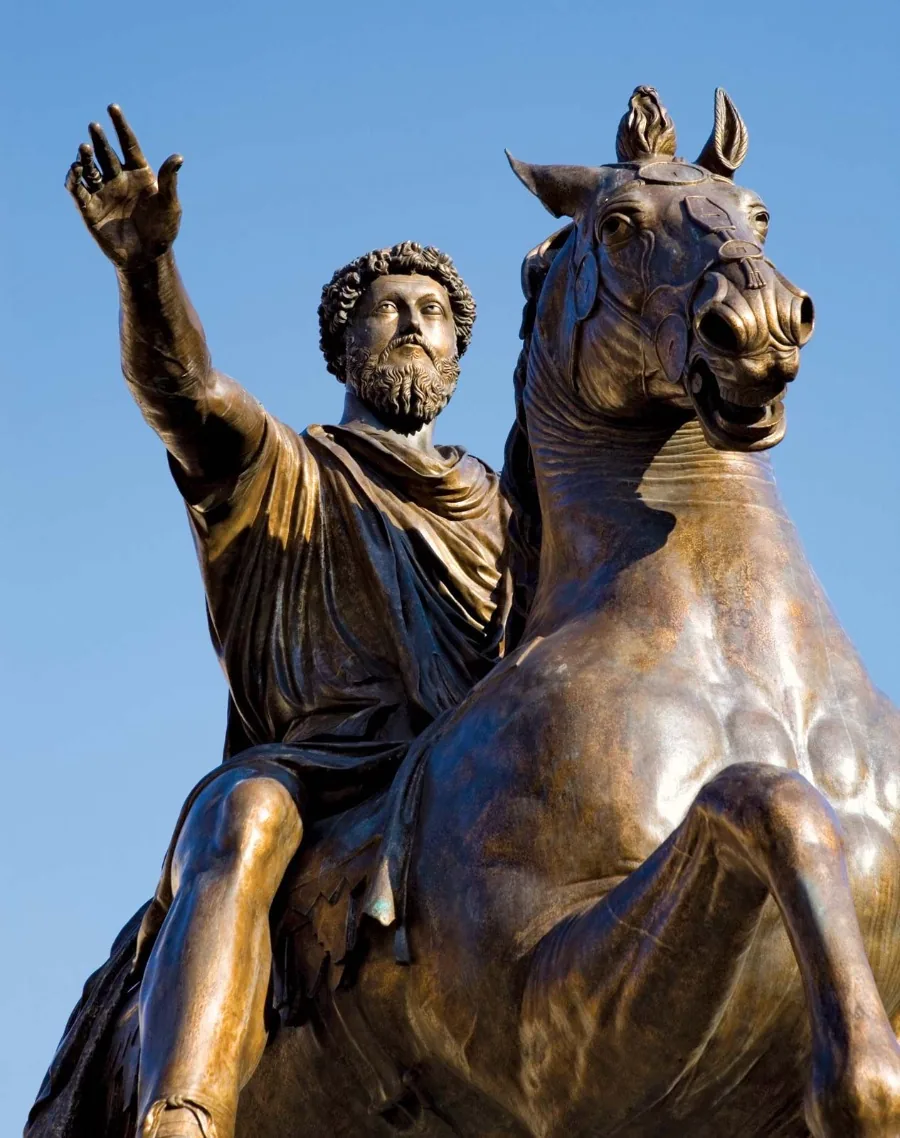
Around the year 170, Marcus Aurelius was emperor of Rome, about the most powerful man in the world. He had everything people chase today: unlimited power, wealth, status. And it was precisely he who held one thing in front of himself, in a diary never meant for anyone else: don’t become a Caesar, stay simple.
That diary, the Meditations, shows no iron, feelingless man. It shows someone who struggles to get out of bed, who knows grief and lost several of his children young. Being stoic didn’t mean feeling nothing to him. It meant facing what you feel and handling it with reason. Not only anger, but also the urge to dominate another, he saw as a sign of weakness, not of strength. Real strength, he held, lay in gentleness and self-control.
He spent years at the front, but wrote about the pointlessness of fame and saw the pomp of a triumphal parade as nothing more than empty show. The only harvest of a life, he noted, was a clean character and acts for others. Not victory, not standing.
So the man held up as the example of dominance lived exactly the other way round: mastery over himself instead of control over others. That’s the strength this story is working towards.
But what the manosphere sells is a return to a world that no longer exists. The old currency, muscle and physical dominance, lost its value in a world that now runs on knowledge, technology and AI, where status is earned with your head and with cooperation rather than with your fists. It’s the old hierarchy dressed up in crypto and discipline: an addictive painkiller. It numbs the feeling of not mattering, but never cures it.
But the painkiller has a price. What feels like something to hold on to turns out to be a cell door.
Read chapter 2 for what that prison does to him.